
Summary
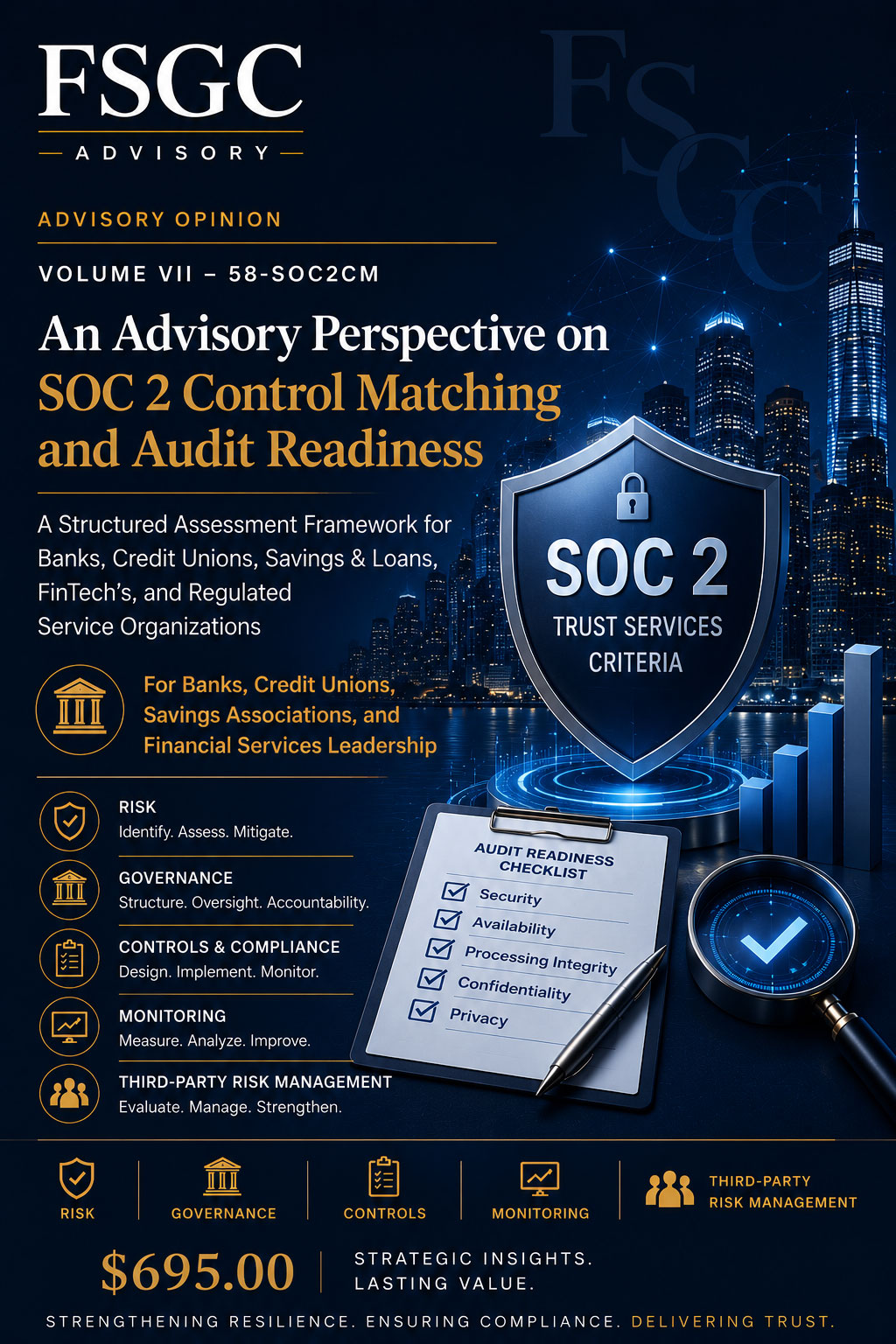
SOC 2 has evolved far beyond an independent attestation report—it has become a strategic governance framework that customers, regulators, business partners, and executive leadership increasingly rely upon to evaluate an organization’s operational maturity, cybersecurity posture, and ability to protect sensitive information. Successfully achieving and maintaining SOC 2 compliance requires much more than implementing technical controls; it demands executive governance, disciplined risk management, operational accountability, well-designed internal controls, continuous monitoring, and a sustainable compliance program.
This comprehensive executive advisory publication provides a practical roadmap for understanding, implementing, governing, and auditing a mature SOC 2 program. Designed for executive leadership, boards of directors, risk management, compliance professionals, internal auditors, technology leadership, service organizations, and financial institutions, the publication explains not only the Trust Services Criteria but also the governance structures, operational processes, documentation expectations, third-party dependencies, audit considerations, and regulatory perspectives that support long-term success.
Rather than simply describing SOC 2 requirements, the publication demonstrates how those requirements can be integrated into an organization’s broader governance, risk, compliance, cybersecurity, operational resilience, and internal control framework. Throughout the publication, practical examples, management considerations, advisory perspectives, and implementation guidance provide readers with actionable insight that can be immediately applied within their organizations.
Topics include executive governance, organizational accountability, Trust Services Criteria, risk assessment methodologies, policy development, evidence management, operational oversight, third-party and fourth-party risk considerations, audit preparation, customer assurance, continuous monitoring, regulatory expectations, and strategic recommendations for building a sustainable SOC 2 control environment.
Whether preparing for an initial SOC 2 examination, strengthening an existing compliance program, or improving overall governance maturity, this publication serves as a practical executive reference designed to help organizations move beyond compliance and establish a resilient, well-governed operational control environment.
Table of Contents
- Executive Summary
- Purpose of SOC 2 Control Alignment
- How the Components Work Together
- Understanding the SCO 2 Environment
- Governance and Risk Foundations
- Step 1 — Defining Scope and Audit Objectives
- Step 2 — Collecting Organizational Control Documentation
- Step 3 — Building the SOC 2 Control Mapping Matrix
- Step 4 — Assessing Control Design Effectiveness
- Step 5 — Assessing Operating Effectiveness
- Step 6 — Identifying Control Weaknesses and Improvement Opportunities
- Step 7 — Evidence Validation and Audit Traceability
- Step 8 — Reviewing the System Description
- Step 9 — Identifying Complementary User Entity Controls (CUECs)
- Step 10 — Conducting a Formal Readiness Assessment
- Step 11 — Remediation and Control Enhancement Activities
- Step 12 — Audit Readiness Testing and Mock Validation
- Step 13 — Preparing for Auditor Interaction and Requests
- Step 14 — Exception Management and Risk Evaluation
- Step 15 — Finalizing the SOC 2 Alignment Package
- Risk Considerations and Common Audit Failures
- Executive and Board-Level Considerations
- Executive Oversight, Management Reporting, and Board Communication
- Strategic Advisory Perspective and Conclusion
Appendix A – SOC 2 Control Design and Documentation Quality Assessment
Appendix B – Reference and Source material




Reviews
There are no reviews yet.